What happens to a trade secret when technology moves on?
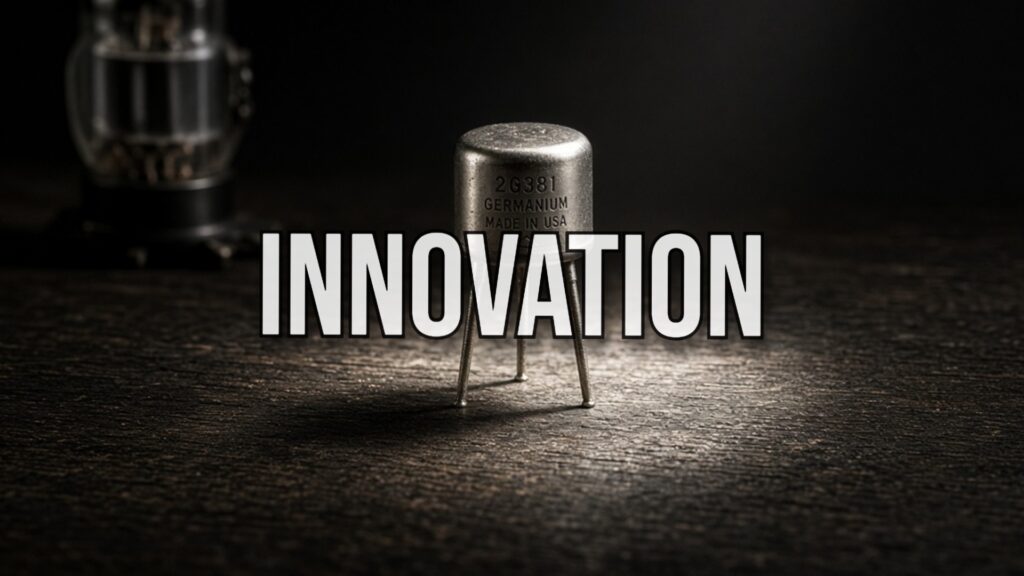
The secrets of building a great vacuum tube did not have to leak for their value to wane when transistors arrived. AI may create the same problem at extraordinary speed. A new trade secret case involving autonomous trucks asks what happens when costly proprietary know-how developed for one generation of machine learning has much less use in the architecture that replaces it.
Courts have been dealing with versions of this problem for a long time. In 1944, when airplanes and radio were presenting the legal system with what Justice Felix Frankfurter called “totally new problems,” he cautioned courts against decisions that might “embarrass the future.” The technologies change, but the problem remains familiar: the law has to apply established concepts to technical developments that can outrun the assumptions on which those concepts were built.
Artificial intelligence makes the problem particularly interesting because the technology can change so quickly. This is a natural extension and consequence of Moore’s Law. A body of proprietary know-how that took years and enormous expense to develop for one generation of machine-learning technology may be considerably less valuable to someone building with the next one.
A new Texas trade secret case involving autonomous trucks provides a remarkably concrete example.
More than one way to teach a truck
In CreateAI Holdings, Inc. v. Bot Auto TX Inc., No. 15-25-00001-CV, (Tex. App. ___, 15th Dist. Sept. 15, 2026) plaintiff accused defendant of misappropriating technology developed for autonomous trucking. Plaintiff had been a pioneer in the field before winding down its U.S. autonomous trucking operations and eventually pivoting toward AI-powered entertainment. Defendant, founded by plaintiff’s former CEO, continued developing autonomous trucks.
Among plaintiff’s claimed trade secrets were its methods for categorizing and labeling the enormous quantities of road data used to teach an autonomous vehicle how to drive. That work was important because plaintiff’s technology relied heavily on convolutional neural networks.
Training those networks required extensive human annotation. Workers had to examine images collected from thousands of miles of driving, identify objects and hazards, and label them so that the networks could learn what they were seeing. Plaintiff used several separate neural networks to handle different kinds of information. The process was expensive, labor intensive and, unsurprisingly, something plaintiff considered worth protecting.
But defendant was building its system differently. Its technology used a transformer neural network. According to the evidence before the court, that architecture could process large sequences of data, make greater use of self-supervised learning, and operate with dramatically less manual annotation. Defendant also needed only one network rather than the several separate networks plaintiff had used. That technological difference mattered legally.
Plaintiff pointed, among other things, to defendant’s use of certain “red” and “green” classifications that plaintiff had also used. But the court concluded that a shared high-level categorization did not show that defendant had appropriated plaintiff’s much more extensive semantic system. More fundamentally, the evidence supported the conclusion that plaintiff’s annotation conventions simply were not particularly useful to the different technological architecture defendant was using.
Plaintiff’s CEO, now working for defendant, put the point starkly. He testified that material relating to convolutional neural networks was “intrinsically incompatible” with the transformer technology defendant was using.
When the secret stays secret but the world changes
That is what makes the case so interesting. We usually think about the life of a trade secret in terms of secrecy. Did the company protect the information? Who had access to it? Was it disclosed? Were confidentiality restrictions in place? Those questions remain essential. I wrote about that issue as early as 2005, in a case involving password-protected customer information.
And this current case provides a good reminder. The company also claimed trade secret protection for the configuration of sensors on its trucks, but it had publicly displayed the locations and types of those sensors in an investor presentation. So, the court memorably observed that an exterior sensor array could be “no more secret than side-view mirrors of a traditional vehicle.”
But the AI portion of this case illustrates a different way that the practical importance of a trade secret can diminish. The information does not necessarily escape. Nobody necessarily publishes it. No employee necessarily leaves it on an unprotected server. Instead, the technology around it changes.
That possibility becomes especially important as artificial intelligence develops. Companies are investing enormous resources in training methods, taxonomies, annotation systems, ontologies, workflows and other forms of technical and institutional know-how. Some of those assets may be tremendously valuable within a particular technological architecture.
But architecture matters. A method designed to solve an expensive problem in one generation of AI may have much less significance if the next generation solves the problem differently.
Trade secret law in a fast-moving technological world
None of this means that technological obsolescence automatically destroys a trade secret. This case does not establish such a rule, and the case came to the Texas Fifteenth Court of Appeals on an interlocutory appeal from the denial of a temporary injunction. The court was deciding whether the trial judge abused her discretion on a preliminary evidentiary record, not announcing a general doctrine about obsolete technology. The court also relied on other grounds, including problems with secrecy and the absence of irreparable injury.
But the case highlights an increasingly important question. In trade secret disputes involving rapidly changing technology, it may not be enough to ask whether the defendant had access to valuable information or whether two companies use similar terminology. Courts may also have to understand whether the accused technology actually has any meaningful use for the alleged secret.
That is a particularly important question in AI, where the distance between one technological generation and the next can become enormous in a very short time. A trade secret may have no fixed expiration date. Technology, however, sometimes supplies one of its own.
CreateAI Holdings, Inc. v. Bot Auto TX Inc., No. 15-25-00001-CV, (Tex. App. ___, 15th Dist. Sept. 15, 2026)